

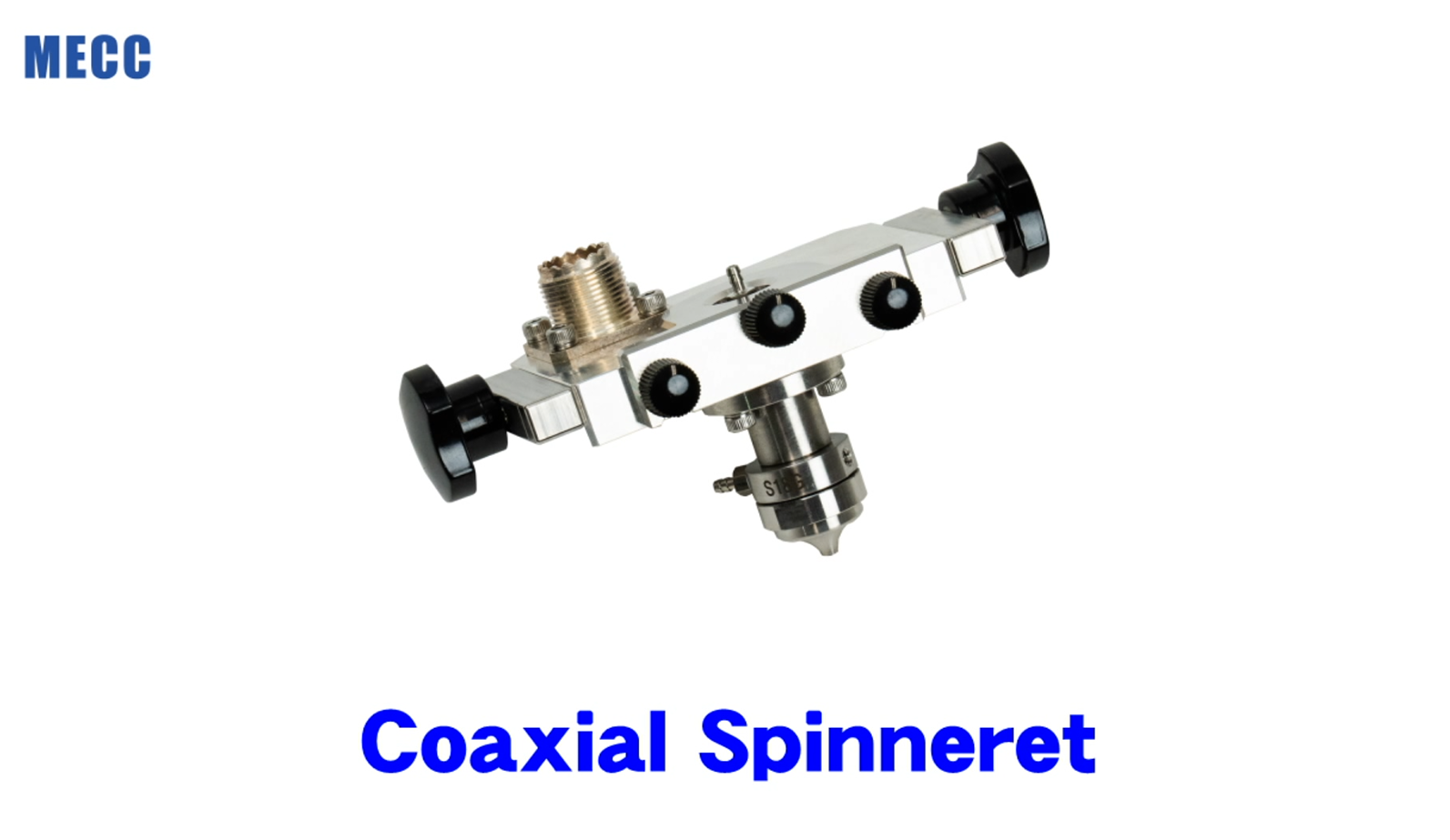
Simultaneous spinning of two solutions with a core-shell structure!! Coaxial Spinneret.
The coaxial spinneret is a spinneret recommended for those who are considering spinning with a hollow fibers or a double-later fibers.It is expected to be used for cosmetics with collagen, complex electrodes with metallic materials, and drug delivery system with PLLA.If you are interested, please feel free to contact us.

Possible to create a tubular nanofiber structure! !! Mandrelcollector
The coaxial spinneret is a spinneret recommended for those who are considering spinning with a hollow fibers or a double-later fibers.It is expected to be used for cosmetics with collagen, complex electrodes with metallic materials, and drug delivery system with PLLA.If you are interested, please feel free to contact us.

Possible to make an aligned sheet!! Drum collector.
By setting a 200mm-wide and 200mm-diameter drum collector for high speed rotation, we electrospun aligned nanofiber sheets like this video.Aligned nanofibers are spun with the fibers aligned in a certain direction, and it will be a sheet with metallic luster.Aligned nanofiber sheets typically for cell culturing.If you are interested, please feel free to contact us.

Can be spun with a small amount of solution!! Tubeless Spinneret.
The tubeless spinneret is a spinneret recommended for those who are considering spinning with a rare (expensive) materials.Can be spun with a small amount of solution.Also, when spinning many different solutions, you can easily test by simply replacing the syringe part.If you are interested, please feel free to contact us.

Joining the Society of Fiber Science and Technology
It’s been a long time since we joined the Society of Fiber Science and Technology last time. This time the exhibition is held at Tower Hall Funabori in Edogawa, Tokyo. Two new members of the staff are doing their best while being tenderly watched by their supervisor. At the booth we are showing the “mobile spinner” which is portable and useful electrospinning machine. Another machine named “NEX-101” is an entry model to make nanofibers. Why don’t you come to our booth to experience electrospinning of nanofibers using the two devices? We look forward to seeing you!

The beginner keeps learning well is our new family member!!
She always keeps happy smile and her best. ‘ I’m into nanofiber technology’she says. Name: Suzuyo Seto Birthplace: Itoshima, Fukuoka, Japan Hobby: Editing videos, Walking my dog Comment: Hello everyone, I’m Suzuyo Seto from MECC company. I’m good at finding the good in people so I love to talk with. Can’t wait for talking everyone about nanofiber and our amazing products. I’m looking forward to see you!
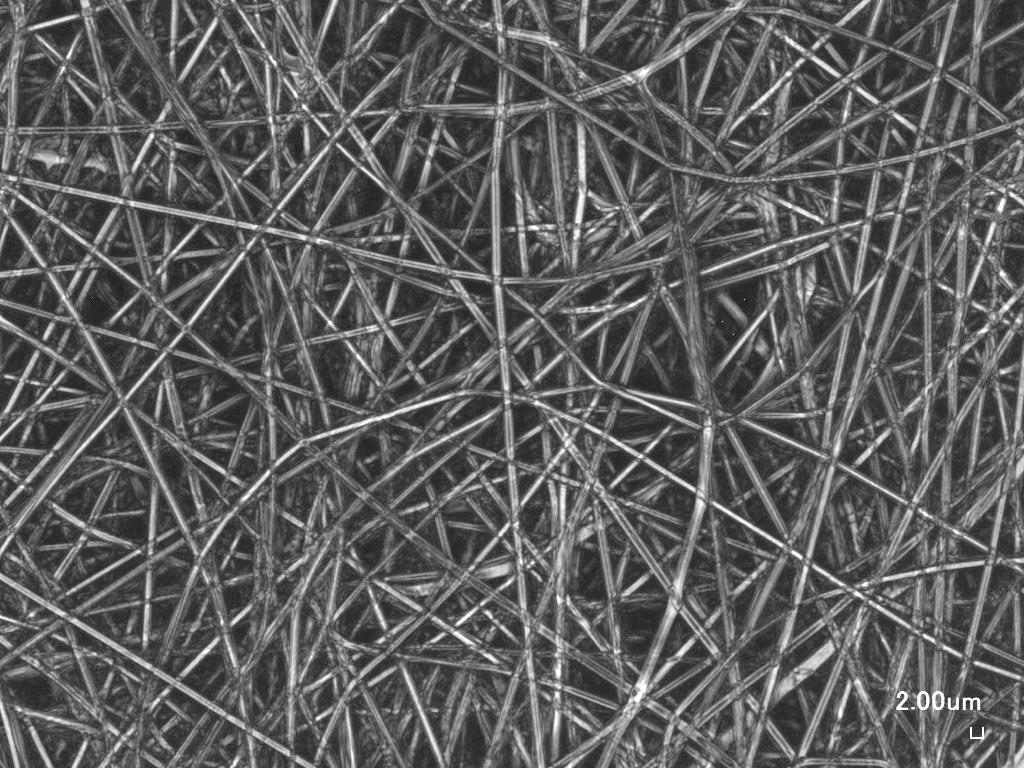
Spinning Gelatin!
We electrospun Gelatin (derived from pig) into nanofiber sheets. Gelatin has biodegradability and biocompatibility, and is used for a variety of medical field such as cell culture medium, wound dressing material, and wound healing.

Electrospinning Method
Major features of the electrospinning method is to spin a variety of materials (mainly polymers) into nanofiber shapes and control of fiber shapes is relatively easy.Research up to now realized electrospinning of the following materials.(See Fig.1) Industrial thermoplastic polymer Biodegradable polymer Polymer blend Composite materials mixed with inorganic compounds Fig.1 Principles of electrospinning In recent years spinning cases of the ceramic nanofibers such as Alumina, Zirconium oxide, Titanium oxide and Lead zirconate titanate are reported frequently.Electrospinning method usually uses solutions in which materials dissolve in solvents as spinning materials.Electrospinning system, as shown in Fig. 1, consists of a high voltage power supply, polymer solutions, a storage tank, a spinneret and a grounded collector. Polymer solutions will be pushed out of a tank to a spinneret at a constant speed. High voltage at 20kV to 40kV will be applied to a spinneret and polymer solution jet will be injected to a collector when electrical attraction exceeds surface tension of polymer solutions. Solvents in jets are gradually volatilized and jets will reduce to nanometer level when they reach a collector. Fig. 2 Electrospun nanofibers forms membranes shown in Fig. 2. Orientations of fibers depend on a collector.Nanofiber membranes are known that its total surface area per volume is much more than that of micrometer-size fiber membranes. Beaded fiber Aligned fiber Nanoflament Fig. 3 As a result, nanofibers obtain unprecedented characteristics by having chemical or physical modifications, and new applications in various fields are expected. As shown in Fig. 3, even if≫ more
Applications of Nanofibers
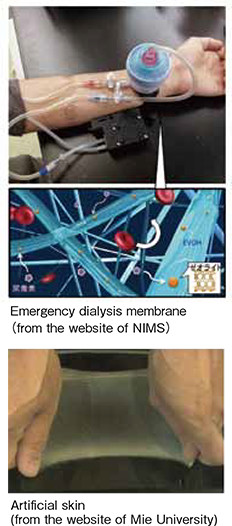
Applications of nanofibers below are currently thought to be promising, and research in such fields is progressing at many colleges, laboratories and corporations. Healthcare Regenerative medicine, wound treatment, drug delivery system Environmental engineering Water filter, dust filter, face mask Functional goods Functional clothes, functional food Electronic materials Battery materials, high conductivity materials, transparent conductive film Healthcare Japanese ministry of economy and industry reports that the market size of goods related to regenerative medicine is presumed to be USD150billion worldwide and USD13billion in Japan. On the other hand a sales record of such products approved by FDA is USD 1billion in 2012 in U.S.A., a leading country in industrializing regenaratve medicine. One of the applications is the artificial blood vessels made by Tokyo Denki University shown in Fig. 6. The group of Prof. Funakubo is developing artificial blood vessels and organs in the field of regenerative medicine. The group is reportedly making experiments to implant artificial blood vessels in rats’ bodies. In such research use of nanofibers is thought to be advantageous in manufacturing 3D structures and scaffold materials of cells. Other than the field of regenerative medicine applications are being developed in wound treatment, drug delivery system and dosage form. Environmental engineering A face mask to which nanofibers are integrated. (from the website of Teijin Corporation) 1 Outer: Prefilter 2 Center: High-performance filter 3 Inner: Nonwovens compounded of Nanofront® nanofibers In the field of environmental engineering nanofibers are well known with products such as filters or face masks.≫ more
Research trends of nanofibers
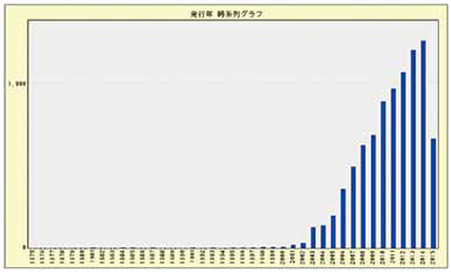
1) Number of nanofiber-related articles Fig. 7 Transition of number of articles related nanofibers (From the website of JST J-GLOBAL) The internet database report tells that number of articles related to nanofibers exceeds 8,000 in Japan as of 2015. As shown in Fig. 7, number of contribu-tions have been rapidly increasing since2006. More than 1,000 articles are being contributed and researches are actively being made all over Japan. 2) Research trends Commercial products that contain nanofibers such as high performance filters and face masks have already been available in the market. They made use of nanofibers of high dust collection efficiency and low pressure loss. In the field of regenarative medicine materials that utilize high adhesion to cells and porosity of nanofibers are developed for scaffolds. Research for composite materials of nanofibers and particles are being conducted worldwide. Materials for the following applications are also under development by making use of features of the both. ・ Electrodes ・ Separation membranes ・ Conductive membranes ・ Sensors ・ Wound treatment ・ Drug delivery system ・ Functional food ・ Functional clothes ・ Functional paint Scaffold that consists of PGA/Collagen composite nanofibers for regenerative medicine by blood vessel induction (from the webste of NIMS) Structure of dust collectors and filters (from the webste of NEDO) 【References】 Scaffold material utilizing nanofibers and its application http://shingi.jst.go.jp/abst/p/13/1330/dendai_7.pdf Patent application No. 2014-87735 https://www.j-platpat.inpit.go.jp/web/all/top/BTmTopPage Patent application No. 2013-124423 https://www.j-platpat.inpit.go.jp/web/all/top/BTmTopPage “High-tech nanofibres could help nutrients in food hit the spot” The website of University of Lincoln http://www.lincoln.ac.uk/news/2015/06/1102.asp “Flexible≫ more